unnamed narrator
You Should Have LeftThe unnamed narrator is the book’s central consciousness: a screenwriter trying to work, a husband trying to understand the repeated strain in his marriage to Susanna, and a father whose concern for Esther remains the most persistent practical obligation amid an increasingly impossible world. His decisive significance lies in the tension between his need to record events accurately and the progressive failure of ordinary language, geometry, memory, and reflection to make those events secure. The notebook begins as an instrument of renewal and ends as evidence whose final image undermines the distinction between observation and disappearance.
Identity and Domestic Situation
The unnamed narrator arrives at the mountain setting with the intention of beginning a new notebook. He treats the change of place as an opportunity for new surroundings, new ideas, and a new beginning, associating the fresh air and expansive landscape with a possible creative and personal reset. The view is sharply concrete: two glaciers appear cold and blue-white above sheer granite, while the woods below become a smooth dark-green surface in the haze and the cloud-frayed sun is edged with fire. This initial act of description establishes him as someone who seeks order through attentive writing, even before the setting begins to resist ordinary perception.
His domestic life is not presented as simply unhappy. Esther has recently turned four, and the narrator notices that everyday childcare has become easier. There is less constant arguing between him and Susanna over who will get Esther up, put her to bed, or play blocks, trains, and Legos with her; Esther can increasingly do things for herself. The narrator also insists that he loves Susanna and does not want another life, even while recognizing that they fight all the time. His attachment is therefore genuine but not stabilizing. Love and conflict occupy the same sentence, and the family’s apparent improvement becomes an unstable baseline against which later disturbances are measured.
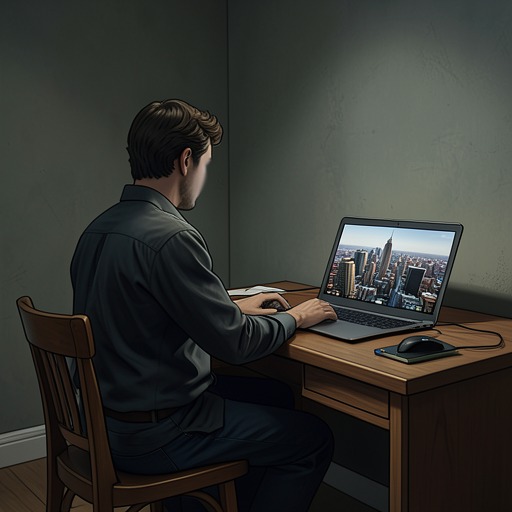
The narrator’s professional identity intensifies this pressure. When Susanna and Esther enter the room while he is trying to write, he cannot focus. He continues scribbling so they will think he is working, because Susanna can dismiss his complaints by saying that he is not working anyway. Yet the performance is not wholly false: he is genuinely busy, since the entire production is waiting for him. He is thus caught between the practical demands of a screenwriter and the domestic scene he claims to value. Writing is labor, concealment, self-defense, and eventually the only method by which he can keep himself composed.
Perception, Dreams, and the Notebook
The narrator’s account is internal and first-person, but his authority becomes increasingly conditional. After what he describes as a blissful evening, he cannot understand why he has had a disturbing dream. The dream presents an empty room with a naked lightbulb, a three-legged chair whose fourth leg has broken away, and a locked door. The question of what he feared in that room is left unresolved. Most disturbing is the woman with the narrow eyes, whose closely set eyes, deep nasal wrinkle, furrowed forehead, slightly open lips, and yellowish smoker’s teeth make her appearance precise without making her identity intelligible. The narrator’s attention repeatedly returns to the eyes as the feature that exceeds description.
By December 5, while Susanna and Esther remain asleep and the sun is about to rise, he is alone in the living room asking where the dreams come from. His hands are trembling, and he tells himself to try, to take one thing at a time. The notebook therefore functions less as a neutral record than as a repeated effort at self-regulation. When Susanna is gone and Esther is asleep upstairs, he writes that he has to pull himself together and wonders what he will do when Esther wakes and what he will tell her. Writing gives shape to panic, but it does not restore control; it makes the narrator’s distress legible while preserving its fragmentation.
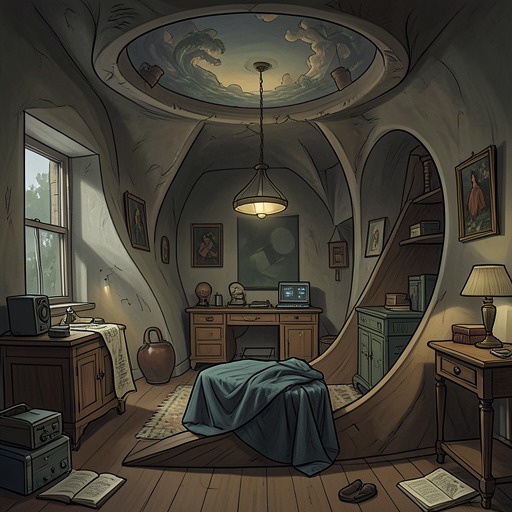
The gap between what the narrator sees and what he can affirm becomes central to his narrative role. He reports a man who appears briefly in the room, tired rather than dangerous, standing on the ceiling and looking down as though asking for help. The man is not the bearded figure in the framed photograph, although the narrator thinks he resembles the woman with the narrow eyes. Even as he records the image, he admits that exhaustion may have caused him to imagine it. The same uncertainty surrounds his sight of multiple doors leading through successive empty rooms, each containing a lightbulb and an open door, with possible movement in the third room. The narrator’s caution does not eliminate unreliability; instead, it makes uncertainty part of the evidence.
Marriage and the Discovery of David
The narrator’s marital conflict first appears in small exchanges that become charged because neither spouse can tolerate the other’s tone. At dinner Susanna asks twice what is wrong. He answers that nothing is wrong and asks why she is asking, then counters her criticism by saying that she is acting strangely. Esther’s account of a preschool friend, confused among several possible names and incompatible versions of what happened, briefly changes the emotional temperature. The adults respond with enthusiastic approval, and their relief when Esther stops talking brings them closer together. The child’s presence thus temporarily buffers the marriage, even as the narrator’s account reveals how readily parenting becomes a shelter from direct confrontation.
The shelter collapses when the narrator confronts Susanna about messages from a man named David. He has copied the messages into his notebook and demands to know who David is. He experiences the scene as resembling one of his own films, but the comparison offers no protection: fictional collapse can be entertaining because characters produce clever lines, whereas the real collapse appears dismal and repugnant. Most damaging is Susanna’s calm refusal to deny the accusation. Her response confirms the infidelity that the narrator had hoped she would disprove, turning suspicion into knowledge and the notebook into a record of betrayal.
The confrontation also shows how quickly the family system reorganizes around Esther. Susanna tells the narrator to pull himself together and think of his daughter. She then picks Esther up, kisses her, and carries her upstairs, speaking to her calmly and maternally despite the narrator’s breakdown. Esther initially whines that it is still light and not late, but Susanna takes her out of the room. The narrator remains motionless and unable to think while hearing Susanna move upstairs and speak with Esther. His emotional collapse is therefore placed beside Susanna’s continued performance of maternal steadiness, while Esther becomes both the moral focus of the argument and the person least able to understand its cause.
Encounter with Impossible Space
The narrator gradually shifts from treating the disturbances as personal dreams to identifying a problem in the place itself. He concludes that the house is harmless and that the true anomaly is the location: it is simply standing where nothing should stand. This distinction is crucial. The house is not imagined as an intentional predator or a malevolent agent; the danger comes from its relation to a reality in which its position should be impossible. He speculates that other such places may exist on the sea bottom, in untouched mountain caves, or light-years away in the infinite universe. The thought expands the domestic crisis into a cosmological one, replacing the stable world with an infinity containing innumerable regions where the substance of reality becomes thin.
The narrator’s attempt to explain the geometry reaches the limits of the words available to him. He suggests that, beyond the familiar three dimensions, one must imagine another three from the other side, or from within. Yet he immediately doubts the value of explaining this to anyone: those who remain there forever would already know more, while ordinary language cannot capture how the phenomenon really is. The geometry is therefore not merely a puzzle to solve. It exposes the inadequacy of the narrator’s professional tools, since the screenwriter who can construct fictional worlds cannot make this world’s structure communicable.
His movements through the house become inseparable from his responsibility for Esther. The sight of the additional doors occurs while he is carrying her down the hall, after which they are suddenly in the living room and he locks the door. Later, Esther lies completely relaxed and breathes deeply and evenly, appearing freed, while the narrator understands that there is absolutely nothing he can do. The contrast between the child’s calm and his helplessness reverses the expected family hierarchy: the adult remains the one who perceives and interprets, but perception supplies no effective means of protection.
Ending and Narrative Role
The narrator’s final position combines exhaustion, return, and incomplete knowledge. After rain runs down his head, he looks up at the house and sees how different it appears; he slowly goes inside. The movement is not a triumphant escape but a re-entry into the site whose spatial rules have already defeated him. His account closes with rain lines on the window and a reflection in which the living room can be clearly seen: the long table, cabinet, kitchen, and door are all present, but no person appears there. A notebook remains on the table. The object that began as a promise of a new beginning survives as the only visible trace of the narrator’s presence, while the reflection denies the presence that should have produced it.
This ending makes the unnamed narrator both witness and implicated subject. His careful admissions of uncertainty—about the exhausted man, the extra doors, and his own perception—do not resolve whether every reported anomaly is objectively real. At the same time, the recurring concrete details prevent the account from dissolving into mere vagueness: the locked door, the broken chair, the trembling hands, the copied messages, the sleeping child, the ceiling-bound figure, and the empty reflection form a pattern of physical signs. The narrator’s unreliability is therefore not simple deception. It is the narrative form produced when a person committed to recording reality encounters a place where reality no longer behaves as a single, stable surface.
His trajectory moves from hoped-for renewal through domestic strain, marital betrayal, and cosmological disorientation toward a final condition in which writing remains but the writer cannot be located. The notebook preserves the family’s ordinary arrangements and their disintegration in the same medium. It records the narrator’s love for Susanna, his dependence on Esther’s presence, his professional pressure, and his growing conviction that the house is only a symptom of a larger spatial anomaly. His decisive narrative function is to make the reader inhabit that contradiction: every explanation is offered by the person best placed to observe the crisis, and every explanation is weakened by the crisis’s assault on the conditions of observation itself.